
-- by Wes Kirk
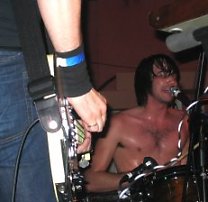 This seemed like a notable sign of fan dedication for what is still a relatively obscure Toronto band. This was nothing. Watching, and being amongst the crowd that was killing themselves dancing to the live show, it was clear to see that DFA-1979 is on to something. It is Rock—the real kind. The kind that even the most deep-rooted wallflowers can’t help but tap their feet to.
DFA-1979 is the duo of Sebastian Grainger, who belts out filthily poetic lyrics and fulfills his duty of keeping the beat by double-kicking and smashing the fuck out of whatever drum kit lays before him, and Jesse F. Keeler, whose relatively average sized fingers are responsible for plucking deep and savage bass lines from his guitar, and for pulling audible garnish out his synthesizers. While DFA-1979 may not currently be enormous in their superstardom or in the size of their band, they certainly are in sound, and the other two may very soon change.
As far as success goes, the devastatingly catchy and overwhelmingly powerful sound of Death From Above 1979 should soon have its name dropping on the heads of disc and video jockeys alike. Don’t bother running for cover; these songs are bunker busters.
Regarding whether or not the plan for the band is to always remain two members, the answer is no. “The plan is to keep writing songs,” says Grainger. Somewhat seriously, he adds, “We’re just a two piece because it’s easy and effective, but there could be a time where we are an eight piece or a 24 piece.” He flips through his manager’s book, trying to figure out, in his words, “why the fuck” tickets are costing $19 at the door. This is ridiculous and way too much as far as DFA-1979—who is clearly for the children—is concerned.
In order to maintain the duo’s raw sound, their must be a proficient dedication to the quality of their music, whether it is on stage or in the studio. I had heard good things about their live shows. They have just come from touring with Billy Talent and Metric, and are now beginning the Vice Records tour. With the ferocity of a DFA-1979 live show, constant touring begins to take a toll.
“In your body the cells die, and there’s a regeneration time before those cells are back to the same state the previous ones were. And you can’t have too many of them at once, or else you get things like leukemia,” prescribes Keeler, lying on the currently empty stage. He then quietly informs me that they are not tired; it’s just that they are decaying. He continues, “What happens is that your so worn down and by the time you get to rest, you haven’t rested back up to the initial state of resting from before, and so…” “We’re like a memory cell battery,” interrupts Grainger. “I have to use all of my energy. Wherever we are playing, we’ve got to relax for a couple hours before the show, because the goal is to be absolutely exhausted after. It’s an all or nothing philosophy.”
They are charging up, conserving their energy. Keeler endures the entire interview on his back, lying on the stage with his girlfriend, speaking always with a slow, slight smile. Grainger is far more tranquil than I had anticipated while listening to You’re a Woman, I’m a Machine, DFA-1979’s debut EP, on the way in. Grainger’s pounding beats and dirty-sexy words delivered in an awesome howl sound like Jeff Buckley on the edges of a two-day crystal-meth binge and a clenched fistful of Viagra.
Now, he peacefully and metaphorically describes working in the studio. “The instruments you’re playing 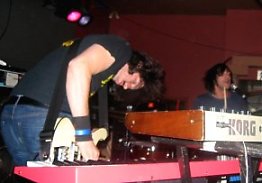 are like the paintbrushes you use to paint,” he explains. “The paintbrushes are not the painting, it’s the method.” With a shrug, he adds, “That’s pretty much how I feel in the studio.” Unlike the horizontal Keeler, Grainger sits calm and cross-legged, hugging his kneecaps and slowly rocking back and forth, as he recalls his musical background.
“My parents were really enthusiastic music fans, and so were Jesse’s, so I've always had that influence. My family was more into playing music than listening to it, and when we listened to it, it would be in a very critical way. We would talk about drum sounds and half tones, how to get certain sounds, the idea of playing to the back of the beat or shifting time signatures. And feel. We would talk a lot about that.”
>>> continued...